
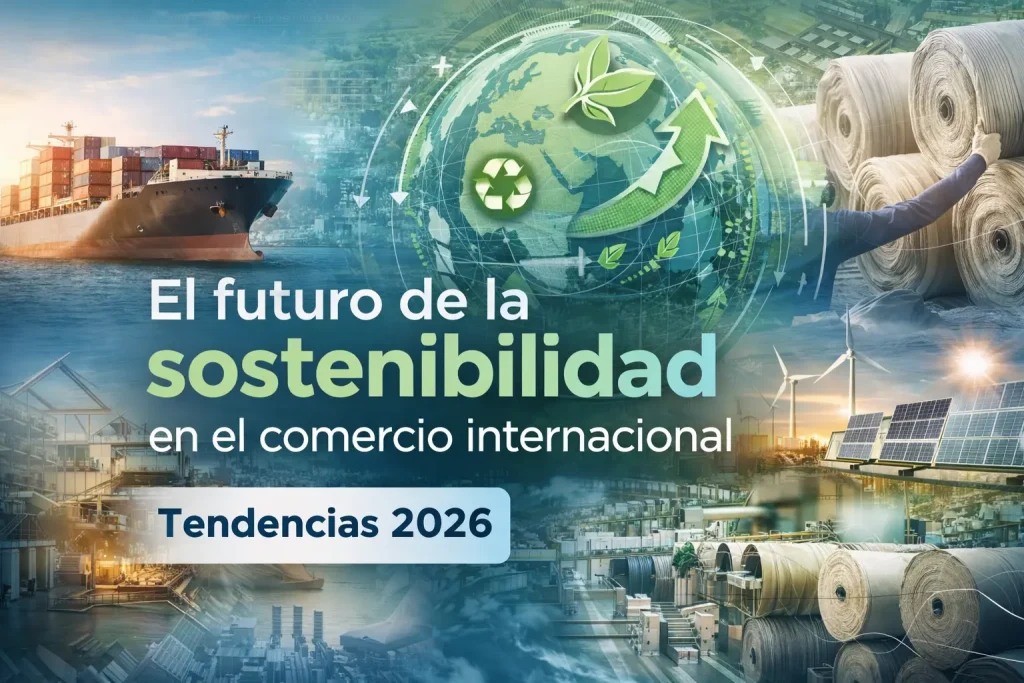
Sustainability is no longer an emerging trend — it has become the new language of global trade.
In the coming years, it will not be only about producing in a cleaner way, but about completely redesigning how industries operate, source and compete worldwide.
At Trade Connect International, we see a clear shift: purchasing decisions are no longer based only on price and quality, but also on impact, efficiency and traceability.
Below are the key trends shaping the future of sustainable global trade.
1. From “eco-friendly” to “business-critical”
Sustainability is no longer a value-added feature — it is becoming a mandatory requirement.
Companies are increasingly facing:
- Restrictions on importing non-sustainable products
- Environmental certification requirements
- Pressure from clients and global markets
In the near future:
👉 sustainability will not be a differentiator — it will be essential
2. Full redesign of the supply chain
The biggest transformation is not in the product itself, but in the entire supply chain.
Companies are now:
- Shortening logistics chains
- Selecting more efficient suppliers
- Reducing unnecessary intermediaries
- Optimizing transport and packaging
This has a direct impact on international trade.
👉 It’s no longer just about buying from China, but how and from whom you buy
3. Smart and efficient production
The next generation of factories is evolving towards:
- Lower energy consumption
- Smart automation
- Waste reduction
- More precise processes
In the textile industry, this is already visible:
- More efficient spinning mills
- Reduced water consumption in dyeing
- Optimization in weaving processes
This transformation is happening across all industries.
4. Future materials
Materials are undergoing a major transformation.
Key trends include:
- High-quality recycled materials
- Bioplastics and compostable alternatives
- Regenerated fibers
- Reduction of unnecessary materials
This impacts textiles, packaging, logistics and industrial sectors.
5. Total transparency as a standard
In the near future, companies will need to demonstrate:
- Product origin
- Production conditions
- Environmental impact
Traceability will become a basic requirement for global trade.
👉 Without transparency, there is no business
6. Asia leading industrial transformation
Asia, especially China, is accelerating the shift towards sustainable models.
Today it is possible to find:
- More efficient factories
- Innovation in energy-efficient machinery
- Development of new materials
However, the market remains highly diverse.
👉 The key difference is choosing the right suppliers
7. Sustainability as a real competitive advantage
Companies that adapt early will not only comply with regulations, but will also:
- Reduce operational costs
- Access more demanding markets
- Strengthen their brand positioning
- Build long-term trust
Conclusion
Global trade is entering a new phase.
Sustainability is not a trend, not an option, and not just a marketing strategy.
It is a structural transformation redefining how business is done worldwide.
At Trade Connect International, we support our clients in this transition by helping them find reliable suppliers, optimize operations and adapt to the new global market standards.
The future of trade is already underway.
If your company needs to adapt to these new trends, we can help you find the best solutions on a global level.