
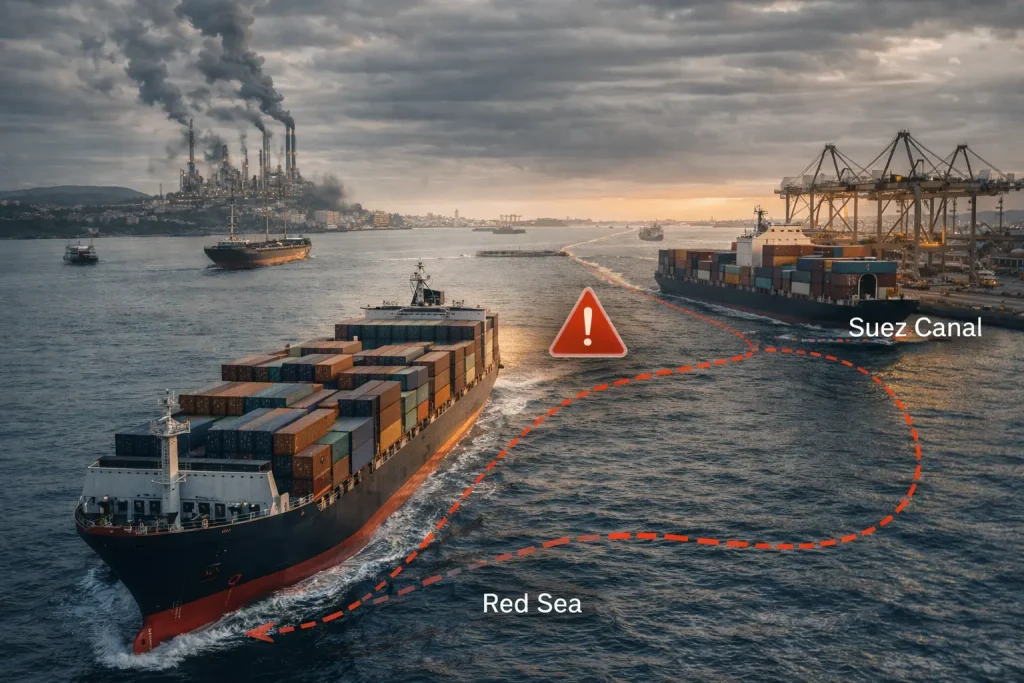
In recent months, international trade has begun to face new challenges related to maritime transport, one of the key pillars of global logistics.
Geopolitical tensions in strategic regions, along with disruptions in major routes such as the Red Sea and the Suez Canal, are forcing companies to rethink their import and export strategies.
These changes are affecting not only transit times, but also operational costs and logistics planning worldwide.
Changes in key global trade routes
Some of the world’s most important shipping routes have been affected by conflicts and operational risks.
In many cases, shipping companies are rerouting vessels through longer paths to avoid high-risk areas, leading to increased transit times and higher costs.
This directly impacts supply chain efficiency.
Rising logistics costs
One of the most immediate consequences is the increase in transportation costs.
Key factors include:
• higher fuel consumption • increased insurance premiums • limited shipping capacity • congestion in alternative ports
For many companies, this creates significant pressure on import cost structures.
Impact on delivery times
Route deviations are causing delays in global shipments.
This is especially critical for companies operating with:
• just-in-time production • low inventory levels • time-sensitive supply chains
Logistics planning now requires greater anticipation and flexibility.
How companies are adapting
In response, many businesses are implementing new strategies:
• supplier diversification • increased safety stock • alternative logistics planning • renegotiation with suppliers
These actions aim to reduce risk and ensure operational continuity.
The role of Trade Connect International
At Trade Connect International, we support companies in managing their international operations.
Our approach focuses on anticipating global changes, optimizing supplier sourcing and coordinating efficient logistics solutions.
Conclusion
Changes in maritime routes represent one of the most significant challenges for international trade in 2026.
Companies that adapt quickly to this new environment will be better positioned to remain competitive and ensure business continuity.